

How to Wash a Cooling Blanket (So It Stays Cool)

- Cold water, gentle cycle, mild liquid detergent, washed on its own. Then air dry out of direct sun.
- Fabric softener is the real culprit, not washing. It leaves a waxy film on the exact surface that carries heat away from you.
- The dryer is the other one. Tumble heat dulls a slick weave permanently.
- If it has stopped feeling cool, it is usually buildup. One cold wash with no detergent at all often brings it back.
- Sweat smell that will not shift responds to a cool soak in white vinegar before the wash.
Here is how to wash a cooling blanket without wrecking it: cold water, gentle cycle, mild liquid detergent, wash it alone, then air dry flat or hang it out of direct sun. No hot water, no bleach, no fabric softener, no tumble dryer. Heat and softener are what kill the cool feel, not washing itself.
That is the short version. The rest of this explains why, what changes by fabric, and what to do about sweat smell and yellowing, which is the reason most people are washing the blanket in the first place.
Can you wash a cooling blanket?
Yes. Almost every cooling blanket sold for home use is machine washable, and it needs to be washed. If you sleep hot or wake up damp, the blanket absorbs sweat, skin oils and whatever detergent residue is already in the fabric. Left alone, that residue coats the surface, and a coated surface feels less cool.
The care label beats any article, including this one. If yours says hand wash only, hand wash it. Manufacturers know what is in their own laminate or finish, and a generic guide does not.
One thing to check before the first wash. If your blanket contains gel or bead fill rather than being a single layer of fabric, treat it as a quilt, not a sheet, and see the fabric table below.
How to wash a cooling blanket in the machine: the exact settings
| Setting | What to use | Why |
|---|---|---|
| Water temperature | Cold, up to 86F / 30C | Heat relaxes and distorts the fine synthetic filaments that give ice-silk its slick surface |
| Cycle | Delicate or gentle | Less agitation means fewer pulled threads and less pilling |
| Spin | Low | High spin creases the weave and stresses the seams |
| Detergent | Mild liquid, small dose | Powder does not always dissolve in cold water and leaves grit in the weave |
| Load | The blanket alone | Zips, hooks and denim rivets snag smooth fabrics |
| Bag | Mesh laundry bag if you have one | Cheap insurance for a large delicate item |
Never use fabric softener. This is the mistake people make most often. Softener works by depositing a waxy film on the fibres, which is the exact opposite of what you want on a surface that cools by conducting heat away from your skin. Dryer sheets do the same thing. Bleach and oxygen boosters are out too.
Wash the blanket every two to three weeks in normal use, and weekly through a stretch of night sweats.
Drying: heat is the enemy
The dryer is the fastest way to ruin a cooling blanket. Tumble heat can shrink the weave, melt or deform synthetic filaments, and leave the surface fuzzy where it used to be slick. Once that texture is gone it does not come back.

What to do instead
- Do not wring or twist. Press the water out, or roll the blanket in a dry towel and press.
- Hang it or lay it flat. A drying rack, a shower rail, or a towel on the floor all work.
- Keep it out of direct sunlight. UV fades and weakens the fibres.
- Give it time. Most cooling blankets dry faster than cotton because they hold less water.
If you have absolutely no way to line dry, use the lowest heat your machine offers, or an air-only tumble setting with no heat, and take it out while still slightly damp. Consider that a compromise, not the method.
Keeping the cooling effect over time

If the sweat smell will not shift. Soak the blanket for 30 minutes in cool water with half a cup of white vinegar before a normal cold wash. Vinegar breaks down the salt and oil residue that holds odour. Do not mix vinegar with detergent in the same soak, and do not use it on anything the label says is silk.
If you see yellow patches. Those are usually old sweat and body oil oxidising, not a stain from the outside. They are far easier to prevent than to remove, which is the real argument for washing more often in summer. Skip chlorine bleach entirely, since on synthetics it tends to set the yellow rather than lift it.
If the blanket has stopped feeling cool. Nine times out of ten it is buildup, not the end of the blanket. Run it through a cold wash with no detergent at all to strip residue, then air dry. If it still feels dull, softener or dryer heat has probably changed the surface permanently.
Storing it off season. Make sure it is completely dry, fold it loosely, and keep it in a breathable cotton bag or pillowcase. Vacuum bags press permanent creases into smooth weaves, and plastic bins trap moisture.
Care by fabric: ice-silk, bamboo, and lightweight throws
Fabric changes the details. This is the table nobody else publishes.
| Fabric | Wash | Dry | Avoid |
|---|---|---|---|
| Ice-silk (smooth synthetic weave, as on Zephyr) | Cold, delicate, mild liquid detergent, alone | Air dry flat or hung, out of sun | Hot water, dryer, softener, rough zips in the same load |
| Bamboo viscose (as on Onda) | Cold, gentle, small detergent dose | Air dry, reshape while damp | High heat, bleach, wringing. Bamboo viscose is weakest when wet |
| Lightweight summer throws (such as Drift) | Cold, gentle, easiest of the three to handle at home | Air dry, dries quickly | Overloading the drum, high spin |
| Quilted or filled blankets | Cold, gentle, large capacity machine | Air dry flat so the fill does not migrate | Hanging while soaking wet, which drags the fill to one end |
One label note worth knowing. In the US a fabric can only be called bamboo if it is made directly from bamboo fibre. Most soft bamboo bedding is actually rayon or viscose made from bamboo, which the FTC has been correcting retailers about for years. It matters here because viscose is the weakest of these fabrics when wet, so the spin speed matters more than the detergent.

Zephyr, double-sided ice-silk
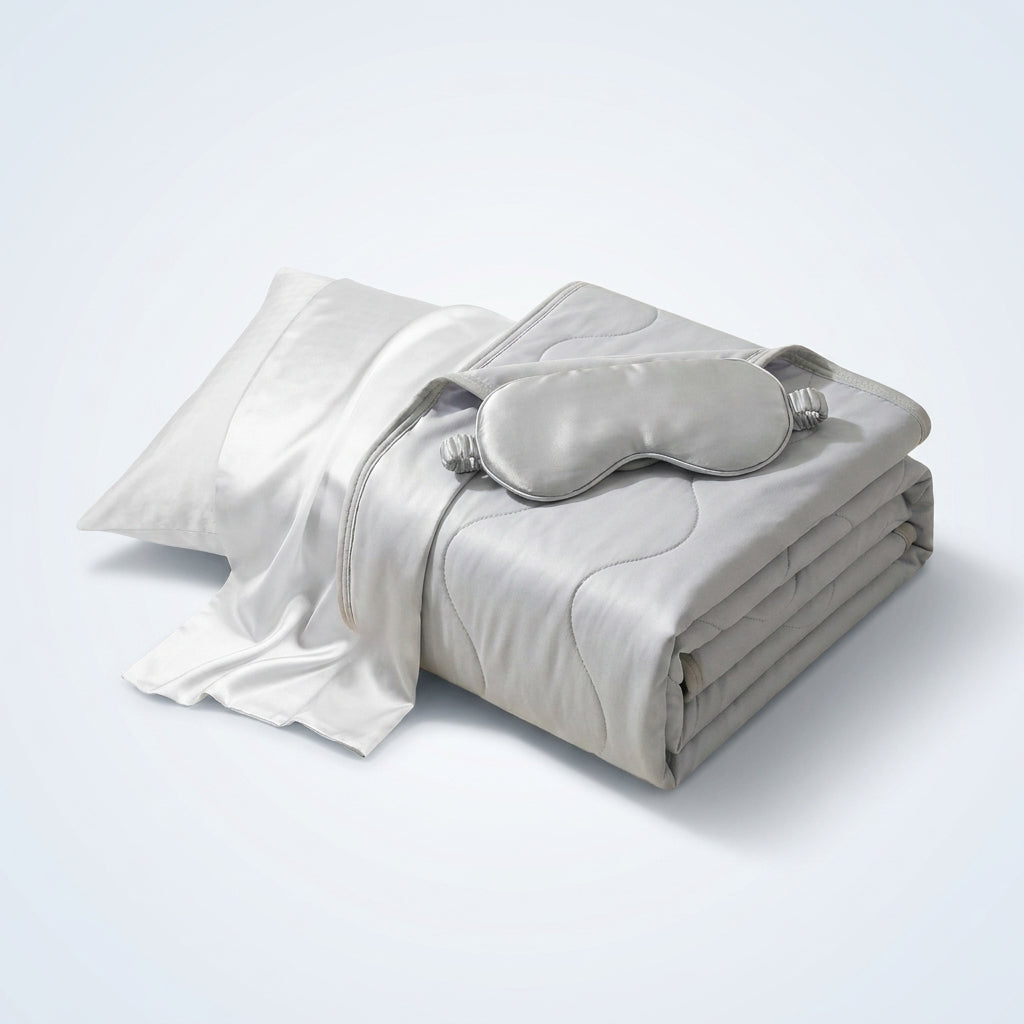
Two faces: a slick ice-silk side for the warm half of the year and a brushed reverse for the cool half. Cold delicate wash, air dry, and the ice-silk face stays exactly as it arrived.
If you are not sure which category your blanket falls into, check the care label, or our FAQ page if it is one of ours.
Washing well protects a purchase, and it protects the reason you bought it.
If the cool feel never really arrived in the first place, the problem may not be your laundry. How cooling blankets actually work explains what these fabrics can and cannot do, and if you are still working out which one suits you, the best cooling blankets for menopause and hot sleepers puts all five side by side. The practical side of sleeping through night sweats is covered in our guide to what is really happening during a hot flash.
FAQ
Can you wash a cooling blanket in a normal washing machine?
Yes, on a cold delicate cycle with mild liquid detergent, washed on its own. Use a mesh bag if the blanket is large or the drum has rough edges.
Can you put a cooling blanket in the dryer?
Best not to. Tumble heat can shrink the weave and permanently dull the smooth surface. Air dry flat or hung, away from direct sunlight.
How often should you wash a cooling blanket?
Every two to three weeks in normal use. Weekly if you are sweating at night, since sweat residue is what makes the surface feel less cool over time.
Why does my cooling blanket not feel cool anymore?
Usually detergent or softener buildup. Wash it once in cold water with no detergent to strip the residue, then air dry. If it stays dull, dryer heat has likely changed the fabric for good.
Can I use vinegar on any cooling blanket?
On synthetics and bamboo viscose, yes, as a cool pre-soak. Not on silk, and not mixed with detergent in the same water. Rinse well afterwards.
Sources
- Federal Trade Commission, Bamboo textiles
- FTC Consumer Advice, 'Bamboo' fabrics
- FTC, Labeling requirements under the Textile and Wool Acts
- US EPA, Safer Choice: certified cleaning products
- Cleveland Clinic, Hyperhidrosis
- American Academy of Dermatology, Hyperhidrosis: diagnosis and treatment
- Cleveland Clinic, Menopause, perimenopause and postmenopause
Researched and written by Claire Bennett. If you are sweating heavily at night and it is new for you, that is worth raising with your doctor rather than solving with laundry.
Blankets that survive the wash
Cold cycle, air dry, and they carry on doing the one thing you bought them for. Bundle two or more pieces and the discount applies automatically.
Shop sleep & comfort


)