


Does Menopause Cause Hair Loss? What Helps, and What's Just Friction

- "Loss" is usually the wrong word. Follicles miniaturise, so each new hair grows finer and shorter.
- Two different patterns get confused. Sudden heavy shedding after a trigger usually recovers. Gradual androgen-driven thinning does not, on its own.
- Acting early matters more than anything else. A follicle shrinking this year responds far better than one dormant for a decade.
- Some of what is on your pillow is not hormonal at all. It is friction damage, and that part you can change tonight.
- No pillowcase reaches a follicle. It protects the hair you already have, which is a real but small thing.
- Does menopause cause hair loss, and why does it happen
- Can menopause cause thinning hair, or is something else going on
- Will hair loss from menopause grow back
- Can you reverse thinning hair after menopause
- What helps hair loss during menopause, day to day
- The one mechanical fix you fully control: your pillowcase
- A gentle night routine for menopausal hair
- When to talk to your doctor
- FAQ
Yes, menopause does cause hair loss for a lot of women, although "loss" is usually the wrong word for what you see in the mirror. As estrogen falls, the balance shifts toward androgens, and androgens gradually miniaturize sensitive follicles so each new hair grows finer and shorter. What you notice is a wider part, less volume and a thinner ponytail rather than bald patches. Some of what ends up on your pillow, though, is not hormonal at all. It is breakage from friction, and that part you can change tonight.
Does menopause cause hair loss, and why does it happen
Every hair on your head runs through a cycle: a long growing phase, a short transition, then a resting phase before it sheds and a new hair starts. Estrogen tends to keep hairs in the growing phase longer. When estrogen drops in perimenopause and after, that growing phase shortens, more hairs sit in the resting phase at the same time, and shedding looks heavier.
At the same time, the ratio between estrogen and androgens changes. Follicles that are genetically sensitive to androgens respond by miniaturizing. The follicle does not die. It produces a shorter, finer, less pigmented hair each cycle, until that hair no longer reaches the length it used to. Dermatologists call this female pattern hair loss. It typically shows as diffuse thinning across the top and crown with a widening part, while the front hairline stays roughly where it was.
There is a second pattern worth knowing, because it is often mistaken for menopause. Telogen effluvium is a sudden, dramatic shed that starts two to three months after a trigger: illness, surgery, a high fever, severe stress, crash dieting, a new medication. It looks alarming, it comes out in handfuls, and it usually settles on its own once the trigger has passed.
Can menopause cause thinning hair, or is something else going on
Can menopause cause thinning hair by itself? It can. It also rarely acts alone in this age range, which is exactly why guessing is a bad strategy.
| What you notice | What it is often linked to | Sensible next step |
|---|---|---|
| Gradual widening part, thinner ponytail over years | Female pattern hair loss | See a doctor or dermatologist, ask about topical options |
| Heavy shedding that started suddenly, 2 to 3 months after a stressful event | Telogen effluvium | Usually settles; review recent triggers and medications |
| Thinning plus fatigue, weight change, feeling cold | Thyroid function worth checking | Ask for a thyroid test |
| Thinning plus heavy perimenopausal periods | Low iron stores | Ask for ferritin and a blood count before supplementing |
| Round, smooth, coin-sized bare patches | Alopecia areata | See a doctor promptly |
| Short broken hairs around the hairline | Traction and breakage | Loosen styles, reduce heat and friction |
Iron deserves a special mention. Perimenopause can bring long, heavy periods, and low iron stores can show up in your hair before they show up anywhere else. Do not start iron on your own, though. Get tested first, because too much iron is its own problem.
Will hair loss from menopause grow back
The honest answer depends on which of the two patterns you have. Hair shed during a telogen effluvium usually grows back over six to twelve months, and you may see a fringe of short new hairs along the hairline as it recovers.
Androgen-driven thinning behaves differently. It is progressive, and it does not reverse on its own. Miniaturized follicles can produce thicker hair again with consistent use of an approved option, but a follicle that has been dormant for many years responds far less than one that only started shrinking last year. That is the single most useful thing to know about timing: acting early gives you more to work with than waiting to see whether it settles.
Can you reverse thinning hair after menopause
There is no single answer to how to reverse thinning hair after menopause, and anyone selling you one is overselling. There is, however, a short list of options with real evidence behind them, and every one of them belongs in a conversation with a doctor.
Topical minoxidil is the only topical approved by the FDA for female pattern hair loss. It works on the follicle cycle rather than on hormones, it takes three to six months before anything is visible, and progress fades if you stop using it. A brief increase in shedding in the first weeks is expected and is not a sign that it is failing.
Prescription anti-androgens such as spironolactone are used off-label by dermatologists for some women, and they need medical supervision and monitoring. Hormone therapy is prescribed for menopause symptoms rather than for hair, and its effect on hair varies between women. Low-level laser devices are FDA-cleared with modest supporting data. Platelet-rich plasma injections are an active area of research, with protocols and costs that vary widely between clinics.
None of them work quickly, and none hold their result without maintenance. Expect months, not weeks.
What helps hair loss during menopause, day to day
The everyday layer will not out-muscle hormones, but it protects what you still have.
Eat enough protein and enough food generally. Hair is one of the first things the body deprioritizes during rapid weight loss. Keep heat styling lower and less frequent, and let the ends dry a little before you reach for a hot tool. Swap tight ponytails, buns and clips for looser versions, and change where the tension sits. Be gentle when hair is wet, because wet hair stretches and snaps more easily than dry hair.
Does biotin help menopausal hair loss? Probably not, unless you are genuinely deficient, and true biotin deficiency is rare in people eating a normal diet. High-dose biotin also interferes with several common lab tests, including thyroid tests, which is unhelpful timing if you are trying to rule out a thyroid problem. If you want a supplement, tell your doctor what you are taking and why. That is also the practical answer to how to stop menopausal hair loss: rule out the other causes first, then work on the pattern that is left.
The one mechanical fix you fully control: your pillowcase
Here is the part that medical pages tend to skip entirely. You spend seven or eight hours a night with your hair pressed against fabric, turning over anywhere from ten to thirty times. Cotton is absorbent and its weave has more drag, so hair catches, pulls and tangles against it. Add night sweats and it gets worse, because damp hair is weaker hair and cotton holds that moisture against it.
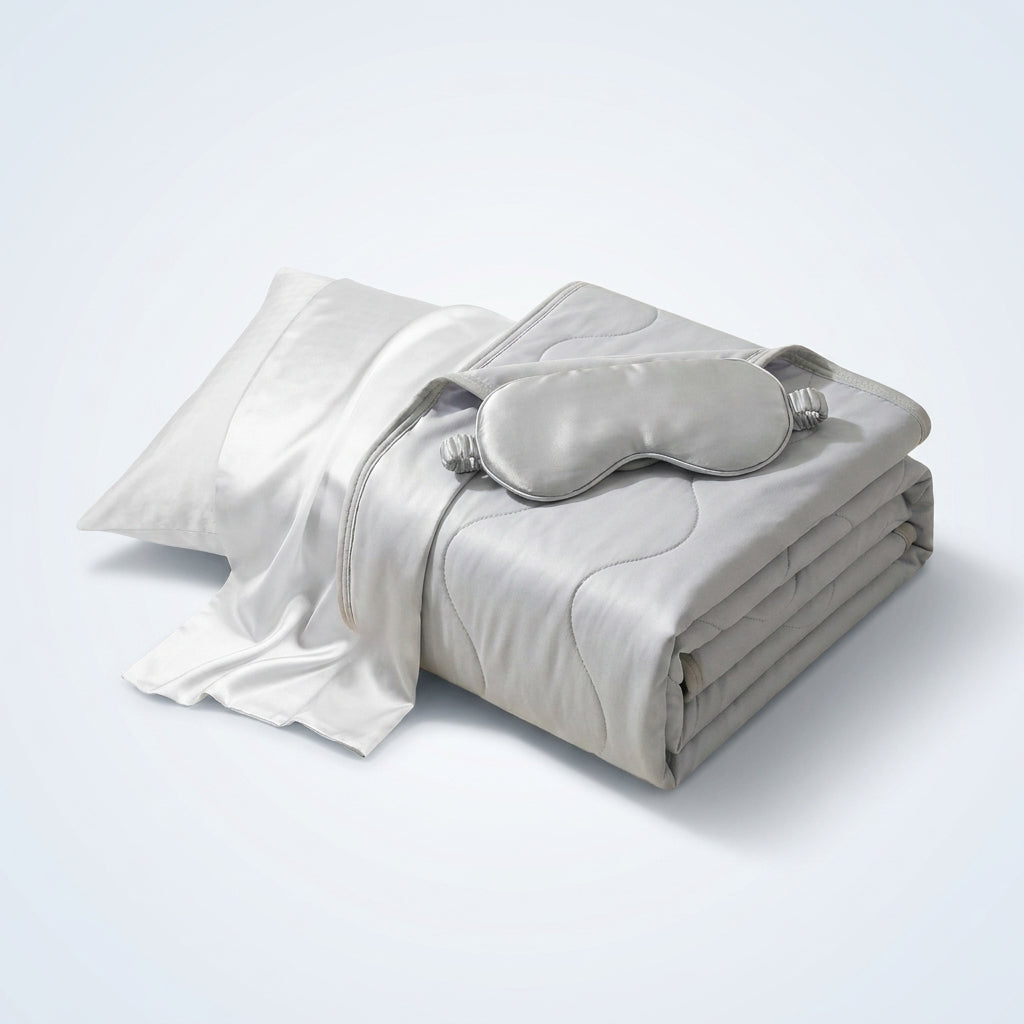
Smoother fabric reduces that drag. A 22-momme mulberry silk pillowcase lets hair slide instead of catching, which usually means fewer tangles in the morning and less snapping along the lengths. A satin pillowcase gives you a similar surface for less money and takes ordinary laundry far better. If you want the full comparison, we wrote about silk versus satin separately, along with what a silk pillowcase actually does.
Now the honest limit. A pillowcase does nothing to your hormones and does not regrow hair. It cannot reach a miniaturized follicle. What it changes is mechanical damage: breakage, split ends, sleep creases and morning frizz. If your problem is thinning at the part, a pillowcase is a supporting act, not the answer.

Soie, 22-momme mulberry silk
Ten to thirty turns a night, eight hours, one surface. Silk lets hair slide instead of catching, which shows up as fewer tangles and less snapping along the lengths. It does nothing to a follicle, and we are not going to suggest otherwise.
A gentle night routine for menopausal hair
Comb through with a wide-tooth comb before bed so you are not tearing knots out in the morning. Gather hair loosely on top of your head, either a loose bun or a loose braid, and secure it with a fabric band rather than a tight elastic with a metal join. The metal join is where hair snaps. Our Lune silk sleep mask ships with a matching silk scrunchie in the box, which is the same idea in a smaller package: a soft, wide, seamless band instead of a thin elastic.
Try not to go to bed with properly wet hair, since wet hair stretches and breaks far more easily than dry. If night sweats are part of your picture, keep a second pillowcase in the drawer so you can swap a damp one at 3am instead of sleeping on it.
One product note, because it gets miscategorized: our Halo is a satin sleep mask, a wide band that wraps the whole head and fastens at the back. It is bought for blocking light, not for your hair. The side effect is that satin, rather than a cotton pillow, is what sits against your hairline all night, which is a small bonus rather than a reason to buy it.
When to talk to your doctor
Book an appointment, rather than waiting it out, if any of the following apply:
Book an appointment rather than waiting it out if: shedding is sudden, heavy, or lasts longer than about three months; there are bare patches, especially round smooth ones, or a scalp that itches, burns, stings or flakes; there is fatigue, feeling cold, weight change or a slower heartbeat alongside it; there is heavy perimenopausal bleeding; there is new coarse facial hair, adult acne or a deepening voice; thinning has visibly progressed over six to twelve months; or shedding began within a few months of a new medication.
Useful things to ask about at that appointment: thyroid function, ferritin and a full blood count, vitamin D, and a referral to a dermatologist if the picture is not clear. Bring photos of your part taken a few months apart. They are more informative than memory, and they give the doctor something to compare against later.
This article is for general information and isn't medical advice.
FAQ
Does biotin help menopausal hair loss?
The evidence is weak unless you have a diagnosed deficiency, which is uncommon. It also skews several blood tests, so tell your doctor if you take it.
Will hair loss from menopause grow back on its own?
Sudden shedding after a stressful event usually recovers within six to twelve months. Gradual androgen-driven thinning does not reverse without medical help.
Do silk pillowcases regrow hair?
No. They reduce friction and breakage, which protects the hair you have. They do not affect hormones or follicles.
Is perimenopausal hair loss different from postmenopausal hair loss?
The mechanism is the same shift in hormone balance, but perimenopause often adds heavy periods and low iron on top, which is worth checking separately.
How long before I see a change after starting an approved option?
Most options need three to six months of consistent use before any visible difference, and progress is judged in photographs rather than in the shower drain.
Night sweats often show up in the same season of life as thinning hair. If broken, sweaty nights are part of your picture, start with our guide to night sweats and menopause.
Sources
- American Academy of Dermatology, Female pattern hair loss
- American Academy of Dermatology, Tips for healthy hair
- Cleveland Clinic, Hair loss in women
- Cleveland Clinic, Menopause, perimenopause and postmenopause
- ACOG, The menopause years
- NIAMS (National Institutes of Health), Alopecia areata
Researched and written by Claire Bennett. This article is for general information and isn't medical advice. Hair loss has many causes and deserves a proper diagnosis rather than a guess.
We cannot help your follicles. We can stop the snapping.
Friction damage and hormonal thinning are different problems, and only one of them is ours. Bundle two or more pieces and the discount applies automatically.
Shop sleep & comfort


