

Night Time Sweats and Menopause: Why They Happen and What Helps

- Falling estrogen narrows the temperature band your brain accepts. Half a degree now triggers a full cooling response.
- One episode runs one to five minutes. The symptom overall has a median of about seven years. Median means half of women have it longer.
- The chill afterwards is part of the same event, and it is the half nobody warns you about.
- Symptoms usually peak around the final period, not at the start.
- Bedding does not touch the cause. It decides whether you are awake for ten minutes or until five.
- Why menopause causes night time sweats
- How long do menopausal night sweats last
- The worst menopause symptoms, and how long menopause symptoms will last
- Night sweats vs hot flashes: the difference
- The fatigue loop: broken nights, exhausted days
- What helps at night: the short version
- Building a cooler bed, layer by layer
- When to talk to your doctor
- FAQ
Night time sweats in menopause happen because falling estrogen unsettles the part of the brain that regulates body temperature, so a change of half a degree that used to pass unnoticed now triggers a full cooling response: blood vessels open, you flush, and you sweat until the heat is gone. Roughly three in four women go through this, and for most it lasts years rather than months, with a median of around seven. This page is the honest version: the biology, the real numbers, why the tiredness hits so hard, and what you can change tonight.
Why menopause causes night time sweats
Your hypothalamus works like a thermostat with a comfort band around its set point. Inside that band, nothing happens. Above it, you sweat. Below it, you shiver.
Estrogen helps keep that band wide. As estrogen falls and swings through perimenopause, the band narrows. A small rise in core temperature that once sat comfortably inside it now reads as overheating, and your body responds at full strength: blood vessels near the skin dilate, your skin flushes, and sweat glands open to dump heat fast.
That is a hot flash. At night it is called a night sweat, and it feels worse for two reasons. Your core temperature is meant to drop as you fall asleep, so any heat load is more disruptive. And you are under a duvet, on a mattress that has been storing your body heat for hours, with nowhere for that heat to go.
Then comes the second half, which nobody warns you about: the chill. Once the flash passes, evaporating moisture keeps pulling heat out of you. You wake damp, then cold, then pull the covers back on, and the cycle sets up again.
How long do menopausal night sweats last
A single episode usually runs one to five minutes, with the aftermath (damp bedding, racing heart, feeling wide awake) lasting considerably longer. The symptom as a whole lasts far longer than most women are told. Large long-term studies of women through the menopause transition put the median duration of hot flashes and night sweats at around seven years. Median means half of women have them longer. A meaningful minority live with them for a decade or more, and a small group still gets them into their seventies.
| Stage | What is happening | Vasomotor symptoms |
|---|---|---|
| Early perimenopause | Cycles start varying, hormones swing | Often begin here, often mild at first |
| Late perimenopause | Cycles become irregular or skip | Usually the most intense period |
| Menopause (12 months with no period) | Hormones settle at a lower level | Frequently still at their peak |
| Early postmenopause | The first years after | Gradually ease for most women |
| Later postmenopause | Beyond that | A minority continue for years |
Two patterns show up consistently. Women whose symptoms start early, while periods are still fairly regular, tend to have them longest overall, and smoking is linked to more frequent, more severe episodes. Neither fact is much comfort at 3am. Still, knowing the likely shape of the road beats assuming it should have stopped by now and quietly worrying that something is wrong with you.
The worst menopause symptoms, and how long menopause symptoms will last
Ask a room of women what are the worst menopause symptoms and the answers cluster: night sweats and hot flashes, broken sleep, mood changes and anxiety, brain fog, joint aches, itchy skin, and changes in their hair.
How long menopause symptoms will last varies by symptom, which is why a single answer never fits. Vasomotor symptoms follow the seven-year median above. Sleep problems often track alongside them and can outlast them. Vaginal and urinary changes come from tissue change rather than temperature, and they tend to persist without medical input, so raise them with a doctor rather than filing them under things to endure.
Night sweats vs hot flashes: the difference
Physiologically, they are the same event. The distinction is timing and consequence.
A daytime hot flash is uncomfortable and sometimes embarrassing, but you can step outside, remove a layer or point a fan at yourself. A night sweat happens while you are unconscious, wakes you at the worst point in your sleep cycle, and leaves you in damp fabric with a bed you now have to deal with.
We covered the mechanism in detail in what's really happening during a hot flash, including the common triggers worth tracking.
The fatigue loop: broken nights, exhausted days
Does menopause cause tiredness? Yes, directly and indirectly, and the indirect route does most of the damage.
Three or four wakings a night, each one requiring you to cool down, dry off and settle again, fragments your sleep. You may spend eight hours in bed and get far less usable deep sleep. Then the day arrives: concentration drops, patience is shorter, sugar and caffeine become the coping strategy, and both make the following night worse. Many women describe this as extreme tiredness that no weekend fixes. Menopause can cause extreme fatigue mostly by taking away the repair time your body relies on.
Anxiety about sleep compounds it. You start bracing for the 3am waking, which makes falling asleep harder in the first place. Our guide to menopause insomnia deals with that half of the problem.
How long does menopause fatigue last? Usually it tracks your sleep rather than your hormones. When the nights improve, the days follow within a couple of weeks. That is the practical argument for working on the bed rather than waiting the whole thing out.
What helps at night: the short version
Medical pages explain the biology, then finish with a line about speaking to your doctor. Sound advice, and no use at all to the woman reading this at 3am. Here is the short version, with the full detail in our guide to what actually helps night sweats.
What to change tonight
- Keep the bedroom around 60 to 67°F (16 to 19°C), and get air moving rather than just cold.
- Layer the bed so you can remove one layer at 3am without rebuilding it in the dark.
- Water, a spare top and a dry towel within reach, so an episode does not become a twenty-minute errand.
- Choose fabrics that move moisture instead of holding it against you.
- Track triggers for two weeks. Evening alcohol, a late hot bath, a heavy meal near bedtime and a warm room are the usual suspects, and all of them are yours to change.
- Talk to your doctor about medical options if this is wrecking your sleep. Enduring it is not the only choice.
Building a cooler bed, layer by layer
Work upward from the mattress, because that is where heat is stored.
The mattress layer. Memory foam in particular holds heat and gives it back to you all night. A cooling mattress pad sits between you and that stored heat and moves warmth away from the contact points. It is the layer most people ignore, and the one that runs hottest.
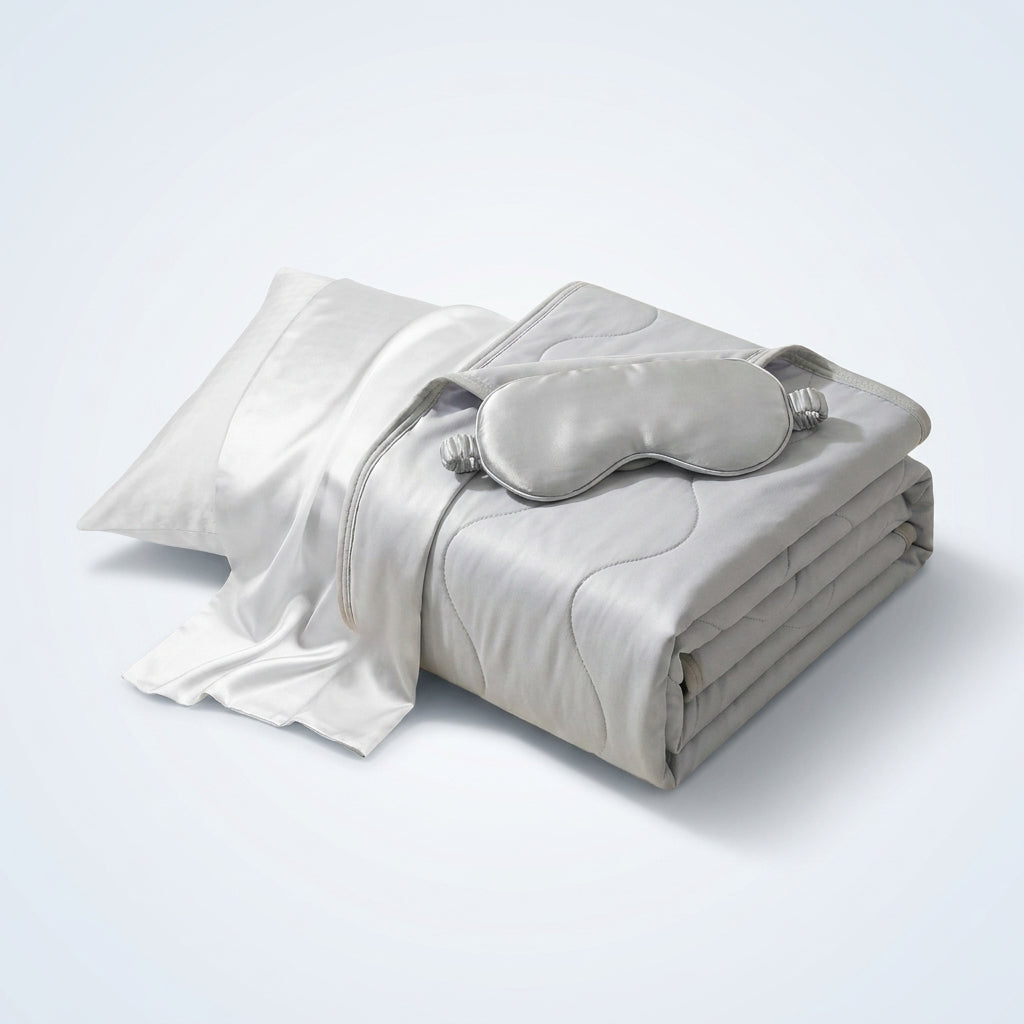
The cover layer. A heavy duvet is the enemy of a body that needs to shed heat fast. A double-sided ice-silk blanket is genuinely useful during vasomotor symptoms for one specific reason: the smooth side draws heat away during a flash, and when the post-sweat chill arrives, you flip to the softer side rather than getting up to find another blanket. See our comparison of cooling blankets if you want the full breakdown, and the best sheets and bedding for night sweats for the layer in between.
The head layer. Your head and neck sweat first and heavily. A silk pillowcase absorbs less than cotton and stays smoother against skin and hair, so you are not sleeping on a damp, warm patch afterwards. Keep a second one in the drawer for a fast swap.
The honest part: none of this touches the hormonal cause. A cooler bed does not stop a night sweat from happening. It shortens the recovery, keeps you drier, and makes the difference between waking briefly and being awake until five. Over a week of nights, that is not small. The full range sits in our sleep comfort collection, and if you also overheat outside the menopause context, why you get so hot when you sleep covers the other causes.

Zephyr, double-sided ice-silk
The smooth face draws heat away during the flash. When the chill arrives twenty minutes later, you flip it instead of getting out of bed to hunt for another blanket in the dark. That is the whole argument for two sides.
When to talk to your doctor
Night sweats in your late forties and fifties, alongside changing periods and daytime hot flashes, usually have an obvious explanation. Some presentations deserve a proper look. See a doctor if:
See a doctor if: your night sweats are drenching and come with unexplained weight loss, fever, a persistent cough or swollen glands; they started before age 40 or long after your periods stopped; they arrived within weeks of a new medication, including antidepressants and some diabetes drugs; you snore heavily, gasp in your sleep or wake unrefreshed even on good nights; you have heavy or unusual bleeding alongside them; or your sleep has been broken for months and your mood, work or driving is suffering.
It is also worth going simply because the symptoms are wearing you down. Prescription and non-hormonal options exist, and a doctor can weigh them against your history. Take a two-week log with you: episodes per night, how severe, what you had eaten or drunk.
This article is for general information and isn't medical advice.
FAQ
How long do menopausal night sweats last?
A single episode is typically one to five minutes. The symptom overall has a median duration of around seven years, and longer for women whose symptoms started early.
Are night sweats and hot flashes the same thing?
Same physiology, different timing. Night sweats are hot flashes that happen while you are asleep, which is why they cost more.
Does menopause make you sleepy during the day?
It commonly does, mostly through fragmented sleep rather than a direct hormonal effect. Improving the nights usually improves the days within a couple of weeks.
Can menopause cause extreme fatigue on its own?
Hormonal change contributes, but persistent extreme tiredness deserves a check for thyroid problems, low iron and sleep apnea.
Will cooling bedding stop my night sweats?
No. It cannot change the hormonal trigger. It shortens how long you stay hot and damp, which is the part that keeps you awake.
Sources
- Cleveland Clinic, Menopause, perimenopause and postmenopause
- ACOG, The menopause years
- National Institute on Aging, Hot flashes: what can I do
- National Heart, Lung, and Blood Institute, Sleep deprivation and deficiency
- Cleveland Clinic, Hyperhidrosis
- Cleveland Clinic, Sleep basics
Researched and written by Claire Bennett. This article is for general information and isn't medical advice. Take a two-week log to your appointment: episodes per night, how severe, what you had eaten or drunk.
Seven years is a long time to sleep badly
Nothing on this page changes the hormones. It changes how long you are awake afterwards, and across a week of nights that is the part that wears you down. Bundle two or more pieces and the discount applies automatically.
Shop sleep & comfort


