

How Do Cooling Blankets Work, and Do They Actually Cool You Down?

- A cooling blanket moves your heat away instead of trapping it. That is the entire mechanism.
- The cold-touch feeling lasts two to five minutes on any patch, then goes neutral. That is thermodynamics, not a defect.
- The honest test is not whether it stays cold. It is whether the space under it stays steady instead of climbing.
- Q-max, the number brands quote, describes the first instant of contact and says nothing about minute thirty.
- It cannot cool your room and it cannot stop a hot flash starting.
How do cooling blankets work? They pull heat out of your skin faster than cotton or fleece does, so the first contact feels genuinely cold, and because they hold almost no trapped air, heat does not build up underneath them through the night. That is the whole mechanism. A cooling blanket is a passive fabric with no power source, so it cannot lower the temperature of your room and it cannot stop a hot flash from starting.
We sell cooling blankets. That makes this the part worth reading, because we are going to tell you where the effect stops.
What is a cooling blanket?
A cooling blanket is a blanket built from fibers and weaves chosen to move heat away from your body rather than hold it in. Most fall into three families: ice-silk (a very fine, very smooth synthetic filament), bamboo viscose, and lightweight cotton or eucalyptus blends in an open weave.
What defines a cooling blanket is mostly what is missing from it. No loft. No brushed pile. No thick air layer. Fleece and down feel warm precisely because they trap a deep cushion of still air against your skin, and still air is one of the better insulators available. A cooling blanket is flat, dense and smooth, so it makes a lot of direct contact with your skin and insulates you very little.
How do cooling blankets work: the science
How does a cooling blanket work at the level of physics? Three things are happening, and only three.
Conduction. Your skin surface sits around 91°F (33°C). A blanket that has been sitting in a 68°F room is roughly 23 degrees cooler. Heat always flows from warm to cool, so the moment the two touch, heat leaves your skin and enters the fabric. How fast depends on the temperature gap, the amount of contact, and how readily the material accepts and spreads heat. Smooth continuous filaments beat fuzzy short fibers on every one of those.
Q-max, the number brands quote. Q-max is the peak rate of heat flow measured at the instant a fabric touches a warmer surface, expressed in watts per square centimeter. Manufacturers generally treat anything above roughly 0.2 as cool to the touch, and higher numbers do correlate with a colder first impression. Here is the catch nobody prints: Q-max measures the first instant of contact and nothing else. It tells you about second one. It says nothing at all about minute thirty.
Airflow and evaporation. Over a full night this matters more than conduction. You lose a meaningful amount of heat through sweat evaporating, and that only works if water vapor can get out through the blanket. A fabric that breathes lets that happen. A fabric that does not leaves you damp and clammy, at which point the cooling effect is over no matter what the label says.
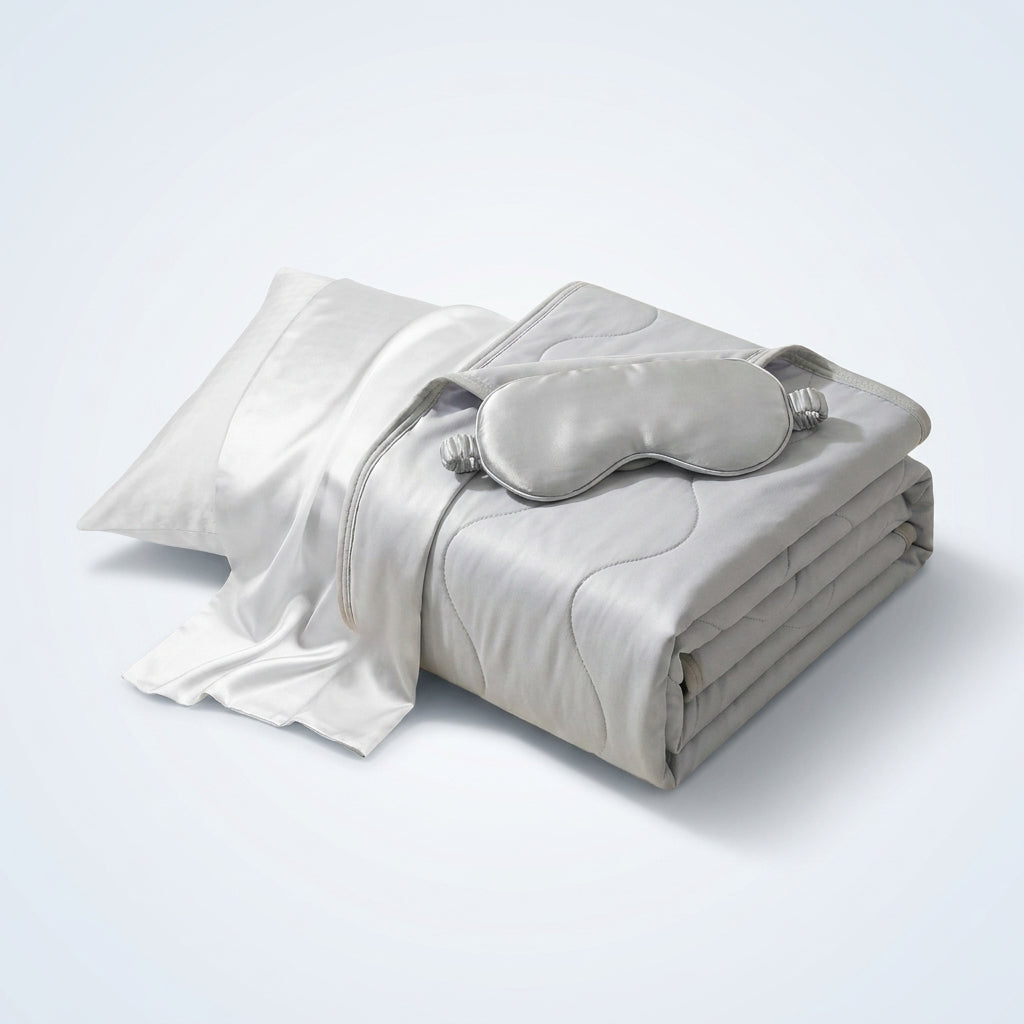
Our double-sided Zephyr is a straightforward illustration of the first two: an ice-silk face for the cold-touch side, a softer knit on the reverse for after the flash passes and you get the chills. Flipping it is not a gimmick, it is how you use a passive fabric in two different states.
One thing we will not do is show you a lab report. We have not put our blankets on a thermal plate or a thermal camera, and we are not going to imply we did. What we can do is explain the physics accurately and let you judge.
Do cooling blankets really work, or is it just marketing?
Both, and the split is fairly clean.
The physics is real and well established. Textile scientists have been measuring thermal contact properties for decades, and the difference between ice-silk and fleece against skin is not subtle. What barely exists is peer-reviewed research on cooling blankets specifically. There is very little published work testing whether people sleeping under one sleep cooler, wake less, or sweat less than people sleeping under an ordinary lightweight sheet. If a brand tells you its blanket is clinically proven, ask which study, and expect not to get an answer.
Then there is the effect everyone notices and few sellers mention. The cold-touch feeling fades in two to five minutes. It has to. Once your skin has warmed that patch of fabric to roughly your own temperature, the temperature gap that was driving the heat flow is gone, and conduction slows to almost nothing. Nobody is cheating you. That is thermodynamics.
Which is exactly why the fresh-patch trick works. Shift your leg six inches onto a section of blanket that has been sitting in room air and it feels cold again immediately, because you have restored the temperature gap. It is also why a larger blanket outperforms a small one for the same fabric.
So the honest test of a cooling blanket is not whether it stays cold. Nothing passive stays cold. The test is whether it stays neutral. Under fleece, your body heat has nowhere to go, so the space under the blanket climbs steadily and by 2am you are throwing it off. Under a good cooling blanket, heat keeps leaving through the fabric as fast as you produce it, so the temperature under there settles and stays settled. Less drama, more sleep. It is a smaller promise than the ads make and a more useful one.
How to read cooling blanket reviews
Cooling blanket reviews split into two piles, and both are usually written in the first week.
The five-star pile is often describing that first cold contact, which every cool-touch fabric delivers on day one. The one-star pile frequently says a version of "it only felt cold for a minute". That reviewer is describing the physics correctly and expecting something no blanket can do.
The reviews worth your time are the three-month ones. Does the surface still feel smooth after twenty washes, or has it pilled where your heels rub? Did the finish survive a hot dryer, which is the single most common way people ruin cooling fabric? Did the seams hold? Is the sleeper writing from Phoenix or from a cold bedroom in Maine, because that changes everything. Also check whether the reviewer sleeps with a partner, since two bodies under one blanket is a far harder job than one.
Weave construction shows up in these long-term reviews more than fiber does. A quilted build like Cirrus holds its shape and its drape through repeated washing better than a very thin single-layer throw, which matters if this is the blanket you use year-round rather than only in July.
Who benefits most from a cooling blanket
Women in perimenopause and menopause. This is our audience and the group the big review sites keep skipping. The value here is specific: not preventing the flash, but shortening the recovery. Heat dumps into a fabric that can take it away instead of reflecting it back at you, and when the chill arrives afterwards you have a second side to turn to rather than getting up for a different blanket. Our explainer on what is really happening during a hot flash covers the mechanism behind that.
- You share a bed with a warmer person. Two bodies make roughly twice the heat
- You have no air conditioning and the goal is stopping heat building up
- You run hot but cannot sleep uncovered, which is more common than people admit
- You want the chill after a flash to have an answer that is not getting out of bed
- Your bedroom is genuinely cold and you want one blanket for all four seasons
- You are expecting the sensation of air conditioning. It is not that
- Your mattress is the real problem. A cooling blanket over a hot foam mattress disappoints
- You are hoping it treats the hot flash itself
When a blanket alone is not enough
The blanket on top of you is one layer of a system, and often not the most important one.
The mattress underneath matters more. You compress the surface you lie on, so heat has nowhere to escape there. Memory foam in particular stores it. This is why a cooling blanket over a hot mattress disappoints people.
Sheets touch more of you than the blanket does. If you are working out where to spend first, start there. We break down fabrics and weaves in our guide to the best sheets and bedding for night sweats.
Room temperature sets the ceiling. Most sleep researchers land somewhere between 60 and 67°F. Below that, bedding barely matters. Above about 75°F, no passive fabric will rescue you. If you have no air conditioning and that is the situation you are stuck with, the room comes first, and we wrote the whole sequence up in how to sleep cool at night without AC.
Layer so you can undress the bed. Rather than one heavy cover, use two light ones so that at 3am you can pull one off without waking up fully or turning on a light.
If you are soaking through nightclothes several nights a week, or night sweats came on suddenly with weight loss or fever, that is a conversation for your doctor rather than a shopping decision.
Ready to pick one? Our full comparison of the best cooling blankets for menopause and hot sleepers puts all five side by side, and the rest of the bed lives in sleep comfort.

Onda, bamboo waffle
An open waffle structure that breathes rather than cools on contact. If your nights end damp rather than simply warm, airflow through the fabric matters more than the first cold touch, and this is the one built for that.
FAQ
Do cooling blankets really work, or is it a gimmick?
The cooling is real but modest. A cooling blanket moves your body heat away instead of trapping it, so the space under it stays roughly steady rather than climbing. It will not make you feel cold all night, and no passive fabric can.
How long does the cold feeling last?
Two to five minutes on any given patch, until your skin warms the fabric to its own temperature. Moving to an untouched section brings the sensation straight back.
Are cooling blankets good for hot flashes?
They help with the aftermath rather than the event. A flash starts with hormonal signaling, so bedding cannot prevent one. A blanket that sheds heat quickly, ideally with a warmer reverse side for the chill that follows, makes getting back to sleep easier.
Do cooling blankets work without air conditioning?
Yes, within limits. Their job is stopping heat from accumulating, which they do in a warm room. In a room above roughly 75°F you will want airflow as well.
Can you wash a cooling blanket without ruining it?
Cold water, gentle cycle, mild detergent, no fabric softener, and air dry. High dryer heat is the fastest way to damage a cooling finish and flatten the fibers that make it work. The settings for each fabric, and what to do when the cool feel has already gone, are in how to wash a cooling blanket.
Sources
- Fabric Selection in Atopic Dermatitis: An Evidence-Based Review. American Journal of Clinical Dermatology, 2020
- FTC Consumer Advice, 'Bamboo' fabrics
- FTC, Labeling requirements under the Textile and Wool Acts
- Cleveland Clinic, Sleep basics
- Cleveland Clinic, Menopause, perimenopause and postmenopause
- National Heart, Lung, and Blood Institute, Sleep deprivation and deficiency
Researched and written by Claire Bennett. We have not run laboratory tests on our own blankets and do not claim to have done so.
A smaller promise, kept all night
Not cold for eight hours. Steady for eight hours, which is the part that lets you stay asleep. Bundle two or more pieces and the discount applies automatically.
Shop sleep & comfort


