
The Best Neck Fans: How to Choose a Bladeless Neck Fan

- Three questions decide it: cold plate or moving air, how quiet, how long between charges.
- A cooling plate chills the skin it touches. It is not a wearable air conditioner and it does not cool the room.
- Moving air works by evaporating sweat, so it loses most of its power in humid air. A plate does not.
- Judge a bedroom fan on its lowest speed, because that is the setting you will actually sleep with.
- We publish decibel and runtime figures only where we have them, and say so plainly where we do not.
- Why bladeless matters
- Is it a wearable air conditioner? What a cooling plate really does
- How quiet is quiet: the 36 dB question
- Battery life and charging
- Best for travel and theme parks
- The best portable fan for hot flashes
- Hands-free cooling through the day
- What a neck fan will not do
- The Seranzio lineup compared
- FAQ
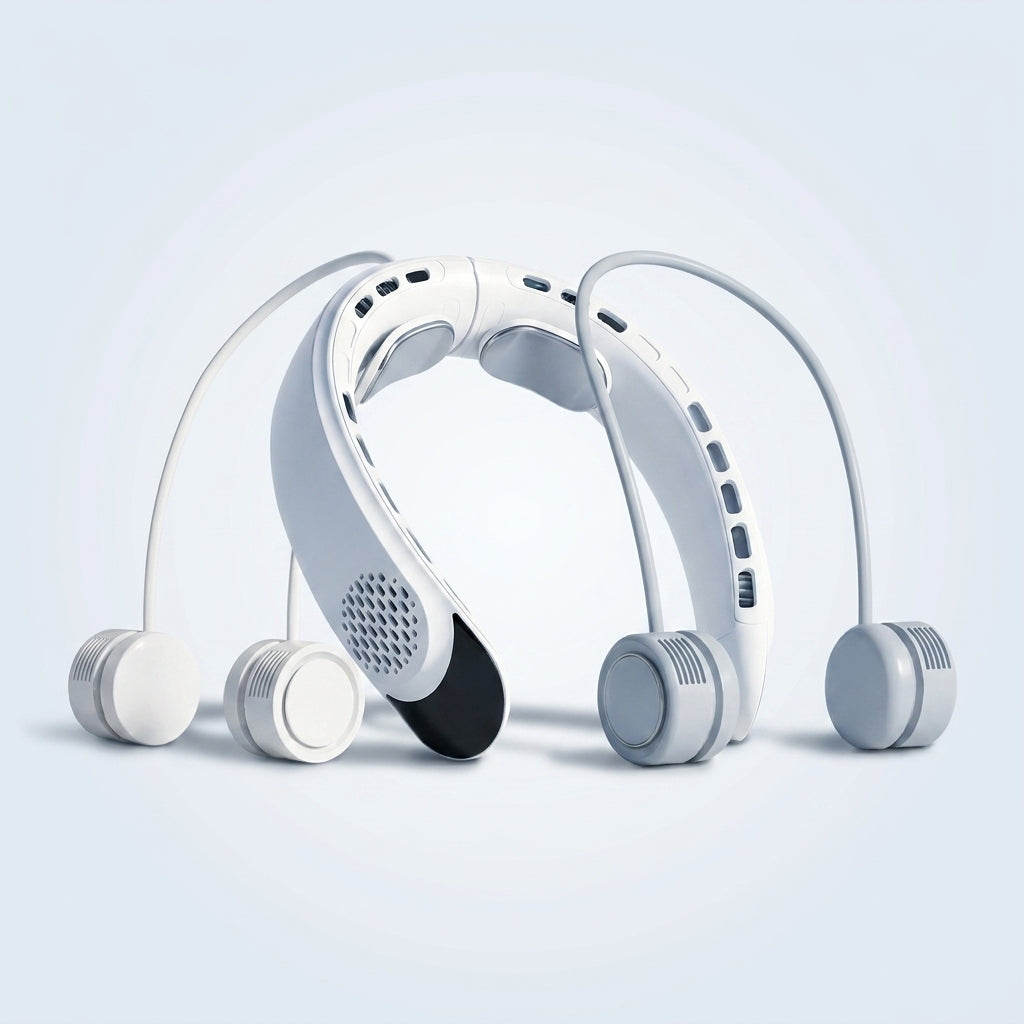
A bladeless neck fan is a small wearable fan that rests on your shoulders and pushes air up along your neck and jaw, with no exposed blades near your hair. Choosing one comes down to three questions: do you want a chilled contact plate or just moving air, how quiet does it need to be, and how long must it run between charges. This guide answers those, compares our four models in a table, and tells you honestly where a neck fan stops being useful.
Worth saying out loud first. The big neck fan round-ups are written for people mowing lawns and standing in theme park queues. One of the most-linked guides runs about 4,500 words and mentions menopause exactly zero times. So does Consumer Reports. The only place we found addressing our reader was a UK forum thread titled "for heatwaves and hot flushes". The demand is obviously there. Nobody had written the article.
Why bladeless matters
Older neck fans were two tiny propellers in cages sitting beside your ears. Long hair finds those cages. So do fine strands at the nape of your neck, which is the worst possible place to be tugged.
A bladeless neck fan hides the impeller inside the body and vents air through slots along the arms. Nothing spins where your hair can reach it. You will also see these listed as a leafless neck fan or a vaneless model, and some sellers call the style a necklace fan because of how it hangs. Same category, different translations. A neck cooler usually means the same thing too.
Two honest notes. "Bladeless" does not mean there is no fan inside; there is, it is just enclosed. And an enclosed design pushes a slightly softer stream than a caged propeller of the same size. You trade a little raw force for not having your hair pulled, which is a trade most people are happy to make.
Is it a wearable air conditioner? What a cooling plate really does
This is the claim that needs unpicking, because "wearable air conditioner" and "ac for the neck" are how these get advertised, and it sets up the wrong expectation.
A neck fan with a cooling plate uses a semiconductor element (thermoelectric, the same principle as a portable cooler box). Our Mistral carries two of these plates against the sides of your neck. They drop by about 15°C in three seconds, and you feel that instantly, the way you feel a cold spoon.
Here is what it is not doing. It is not lowering the temperature of the room, or even the air arriving at your face. It chills the small patch of skin it touches, and the blood moving through it, and your body reads that as relief. A real air conditioner removes heat from a space. A cold plate moves heat from one square inch of your neck to the heat sink on the other side of the unit. The sensation is genuine. The physics is local.
If your problem is a sudden flush that arrives in ninety seconds and passes in three minutes, that local effect is the right tool. If your problem is a 35°C room all afternoon, no wearable will fix it.

Mistral, two semiconductor plates
Two plates sit against the sides of your neck and drop by around 15°C in about three seconds. Read that as a drop of fifteen degrees from where they started, not a plate chilled to 15°C. It cools the skin it touches, which is exactly the right tool for a flush that arrives in ninety seconds.
How quiet is quiet: the 36 dB question
Noise is where most neck fans fail the people who need them most. Something you can wear at your desk or in bed has to disappear.
Two of our four models carry a published figure: the Mistral and the Plume both run under 36 dB. For reference, a quiet library reads around 40 dB and a whisper at arm's length around 30. Under 36 means present but not intrusive: audible in a silent bedroom on the top setting, effectively gone under any background noise. Every model has three speeds, and the lowest one is the one you will actually use indoors.
We have not put the Aero or the Bora in front of a sound meter, so we are not going to print a number for them. Both are quiet in ordinary use. That is a description, not a measurement, and you should read every unsourced decibel figure in this category the same way.
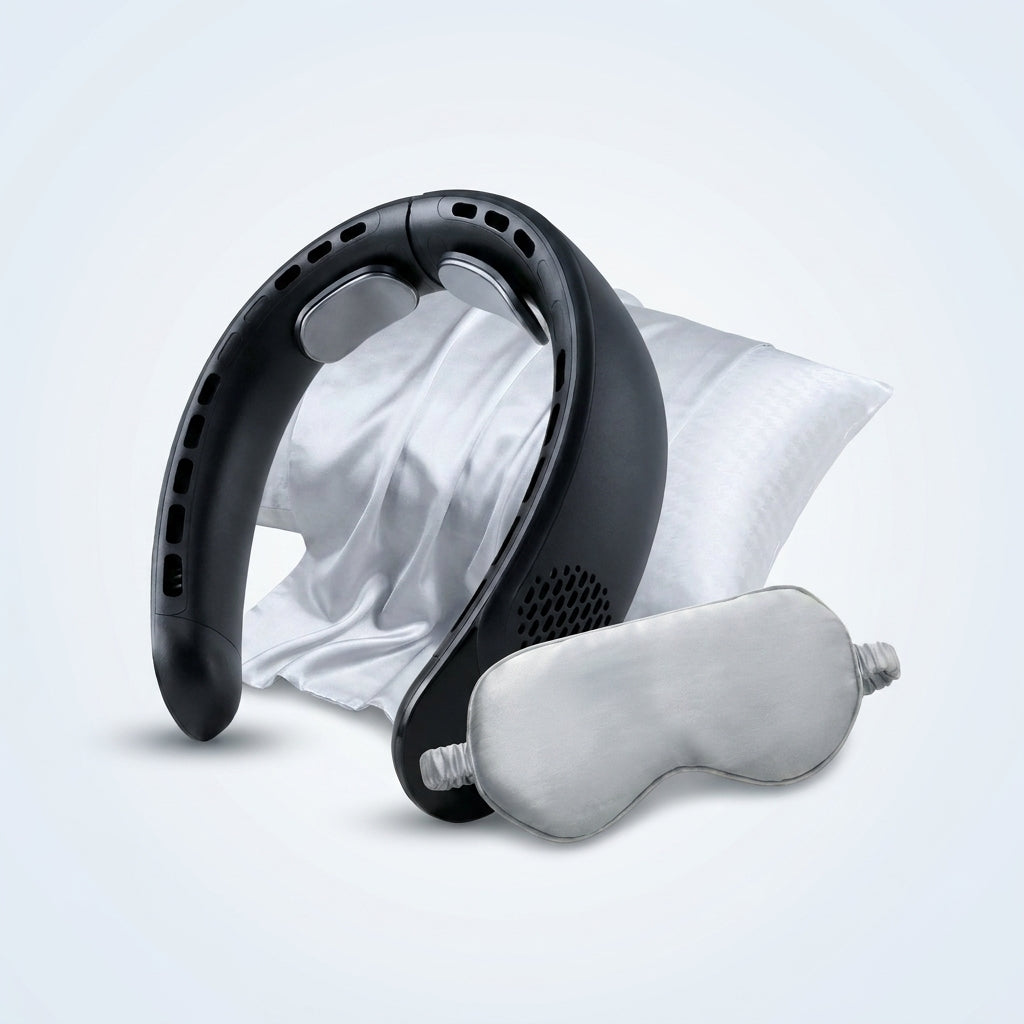
For night, the Plume is the one we point people to. It folds flat, it weighs almost nothing, and it is the model we built around the quiet hours rather than around raw airflow. If you are looking for the best quiet fans for a bedroom, judge them on the lowest speed, not the highest, because that is the setting you will sleep with.
Battery life and charging
The Mistral and the Plume are rated at up to six hours per charge over USB-C. Read "up to" the way you would on a phone: that figure belongs to the gentlest of the three speeds. Run it on high and plan for meaningfully less. We do not publish a runtime for the Aero or the Bora because we do not have a tested figure for them, and a made-up one helps nobody.
Every model is rechargeable, so a neck fan takes the same cable as everything else in your bag. What differs is knowing where you stand. The Bora is a palm-size handheld with a digital charge display, so you see an actual number instead of guessing from a colored LED. On a long travel day that matters more than it sounds.
Best for travel and theme parks
A handbag fan and a shoulder fan solve different problems. Carry the small one for cooling on demand a few minutes at a time. Wear the shoulder one when you need both hands and a continuous stream.
The Aero is our travel pick: 175 g and folds down to pocket size. It also carries a small replaceable pad behind the vent, and this is worth describing accurately because listings in this category rarely do. The pad arrives blank. You add two drops of your own lavender, eucalyptus or neroli, and the scent travels with the airflow instead of sitting in a bottle at home. Three pads come in the box and each one lasts about 30 days. Leave the pad dry if scent bothers you and nothing changes about how the fan works. For the best portable travel fan in a small bag, or the best neck fan for Disney and similar long-queue days, the folding models win because they survive being crammed in with everything else.
About flying. Small fans with built-in lithium batteries are normally fine in carry-on, and lithium batteries are not allowed in checked bags, so pack it in the cabin. Rules vary by airline and country, so check your carrier's page before you travel.
The best portable fan for hot flashes
A flush has a shape. Heat builds in your chest and face over a minute or so, peaks, then leaves you clammy and sometimes cold. A portable fan for hot flashes needs to be reachable in seconds, because by the time you have found it in a drawer the worst has passed.
That is the argument for wearing one rather than carrying one during a bad week: it is already on. Turn it up, let it run through the peak, turn it down. The evaporative effect also helps with the damp aftermath, which people forget to plan for. If you want the biology behind why this happens at all, we wrote it up in what's really happening during a hot flash.
Hands-free cooling through the day
The everyday case for a hands free neck fan is unglamorous: cooking, gardening, ironing, sitting in a car that has not cooled down. A personal cooling device earns its place by being available without a decision. As a neck cooler for hot weather it will not replace shade or water, but it changes what a 30°C errand feels like.
What a neck fan will not do
Nobody writes this part, so here it is.
Long hair still needs managing. Bladeless means nothing spins where hair can catch. It does not mean loose hair will not sit against the vents and flutter annoyingly. Most people end up tying it up or wearing the fan under a low ponytail.
Your neck notices after a couple of hours. These are light, but light is not weightless, and the load sits on your trapezius. Two hours of continuous wear is where people typically start shifting it around. Take it off for ten minutes rather than pushing through.
Humidity beats it. Moving air cools you mainly by speeding up evaporation of sweat. At 35°C with high humidity there is very little evaporation available to speed up, so the fan feels like a hairdryer. The cold plate on the Mistral still helps because it works by conduction, not evaporation. A plain fan does not.
Meetings are a judgment call. Under 36 dB is quiet, not silent, and a microphone will pick up airflow before your colleagues do. On a video call, run the lowest speed or switch it off while you are speaking.
It does nothing about the cause. A fan makes the next four minutes easier. It has no effect on hormones, sleep quality or how often flushes happen.
The Seranzio lineup compared
| Model | Worn or held | Best for | Signature feature | Published specs |
|---|---|---|---|---|
| Mistral | Worn on the shoulders | The worst heat and sudden flushes | Two semiconductor cold plates, a drop of about 15°C in three seconds | Under 36 dB, up to 6 hrs, USB-C, three speeds |
| Plume | Worn on the shoulders | Night and quiet rooms | Folds flat, built for the quiet hours | Under 36 dB, up to 6 hrs, USB-C, three speeds |
| Aero | Worn on the shoulders | Travel and days out | 175 g, folds to pocket size, refillable scent pad | 175 g, three speeds, rechargeable |
| Bora | Held in the hand | Handbag and long travel days | Palm-size turbo fan with a digital charge display | USB-C, digital charge display |
Two things that table is doing deliberately. The Bora is a handheld, not a neck fan, and it sits here because people cross-shop the two rather than because it belongs in the category. And the last column contains only figures we can stand behind. Where a number is missing, it is missing because we do not have a tested one, not because the model is worse.
If you are choosing between two of them, pick on the situation you face most often rather than on the spec sheet: the plate for intensity, the folding models for portability, the quiet one for sleep.
FAQ
Are bladeless neck fans safe for long hair?
Safer than caged models, because the impeller is enclosed and there is no opening for hair to be drawn into. Loose hair can still sit over the vents, so most people tie it back.
How loud is a neck fan, really?
The two models we have a figure for, the Mistral and the Plume, stay under 36 dB. That is below a quiet library. On the lowest of the three speeds it disappears under normal room noise. Be skeptical of any brand quoting decibels without saying at which speed the reading was taken.
Can you take a neck fan on a plane?
Usually yes, in your carry-on, because lithium batteries are not permitted in checked luggage. Airline rules differ, so check your carrier before you fly.
Does a neck fan help with hot flashes?
Many people find it takes the edge off the peak and helps with the clammy stage afterwards. It does not affect why flushes happen.
Which neck fan is best for sleeping?
The quietest one you own, on its lowest speed, angled at your face rather than your chest. If overheating wakes you regularly, it is worth reading why you get so hot when you sleep as well, because bedding is usually a bigger lever than airflow.
All four models, with full specs, live in our neck fans collection. Two or more triggers an automatic bundle discount, worth knowing if you want one for the handbag and one for the bedside.
Sources
- FAA PackSafe, Lithium batteries in carry-on baggage
- NIDCD (National Institutes of Health), Noise-induced hearing loss and the decibel scale
- Cleveland Clinic, Menopause, perimenopause and postmenopause
- ACOG, The menopause years
- Ready.gov, Extreme heat
Researched and written by Claire Bennett. This article is for general information and isn't medical advice. Where we have no measurement of our own, we say so rather than printing a number.
One for the handbag, one for the bedside
A wearable cools the skin near it, not the room. Used for what it is good at, that is often exactly enough. Bundle two or more pieces and the discount applies automatically.
Shop neck fans


